

Printing Terminology: Bleed - The Key to Edge-to-Edge Printin
Bleed is one of the most important factors to consider when sending your artwork to print. The subject of bleed is often misunderstood though and it is one of the most common reasons we have to contact the customer to re-supply their artwork.
What is a Bleed?
If part or all of a design is intended to meet the edge of the sheet it is printed onto then in printing terms the parts that meet the edges are said to "bleed off." They should be extended by at least one eighth of an inch so that the excess can be trimmed off after printing. In addition, we recommend making sure that text and other vital information remains at least three sixteenths of an inch inside the final, trimmed edges.
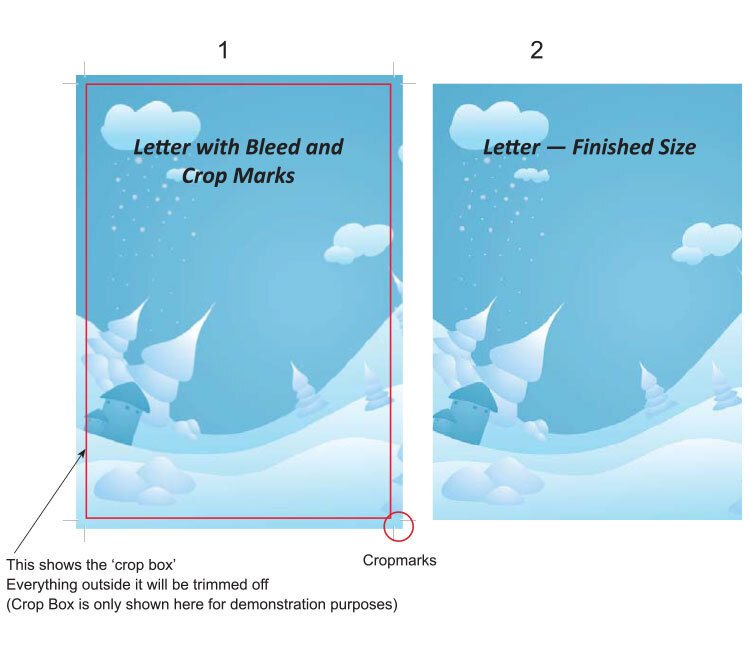
As you can see in the image below, the designer makes the design larger than the page that will be print-ed. The designer also puts crop marks onto the work that show the actual intended size and act as cutting guides during the trimming process.
Let us say that you wish us to print an Letter sized (8½ x 11 inches) flyer with a background that covers the whole sheet.
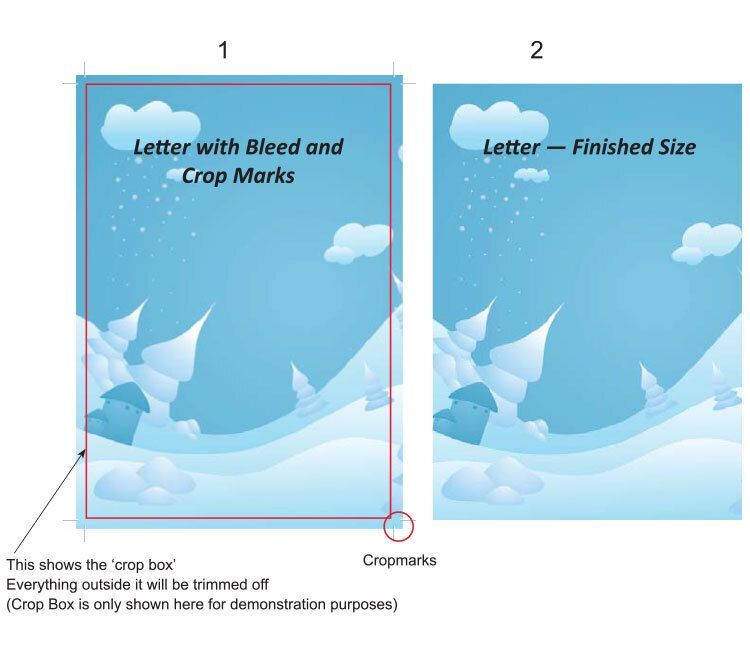
We would need to receive from you artwork that is actually bigger than Letter and with crop marks (see figure 1). We would then print it on a larger sheet and use the crop marks to trim it down to Letter size - therefore producing the desired finished result (see Figure 2).
How do I get bleed?
If your artwork is being created by a designer and then you are forwarding it to us to print, all you need to do is make sure that they supply the artwork in PDF format with one eighth of an inch bleed and crop marks as per the example below.